Becoming a slampion

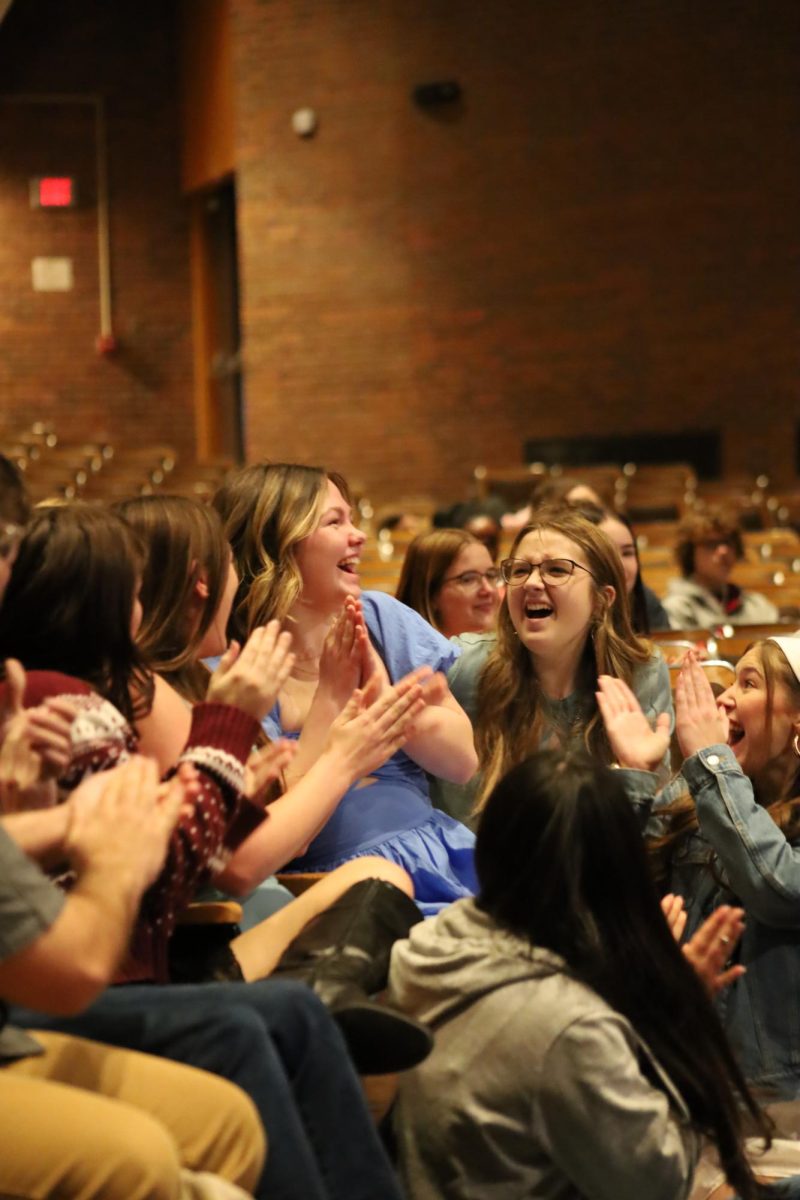
The Poetry Slam has become one of the most anticipated annual events. Now in its fifth year the biggest field ever will try to take home the title of the school’s best poet.

This year marks the fifth annual NW Poetry Slam. The first slam was held in 2006, as a collaboration between librarian Carolyn LaFever and English teacher Lindsay Kincaid in honor of National Library Week and the National Poetry Month in April.

The first year, 14 people participated.

“Nobody really knew what they were signing up for,” Kincaid said. “It was mainly a poetry reading, with an exception of a few people. That first year, we crowned Will Harris the slampion.”

Each year the slam grew, with more than 30 participating in 2007 increasing to more than 50 in 2008. Seventy-two students participated in 2009.

Kincaid thinks bringing in guest performers helped spur the growth. She first learned about spoken-word poetry from her friend, Brendan McLeod, now a world-renowned poet. She watched him compete in the 2005 National Poetry Slam in St. Louis.

“Prior to that, I hadn’t been exposed to it. They have more of a spoken-word vibe up in bigger cities,” Kincaid said. “When I came to St. Louis, I thought, ‘this is something that students can really get behind.’ For me, it was inspired by Brendan. That’s where I’d seen it. I thought let’s see what we can do with that here.”

Kincaid also teaches performance poetry in class. Last year, 35 of the 72 participants were from her 10th grade honors English class.

“We roll out the same poetry style year after year. I think English teachers all agree we teach poetry more literally, and I wanted to bring in something more contemporary, something students could relate to. It’s just like hip-hop, it’s just like stand-up comedy, it’s just like everything you go and look up on YouTube,” Kincaid said. “For me as a teacher, the coolest thing is seeing the kids who never show their face in class find the confidence to get up and perform on stage. This is probably the most rewarding thing I do with my job.”

All of the rules of the school Poetry Slam follow the same guidelines as a national Poetry Slam. For example, the judges for the slam are randomly selected from the audience.

“It is set up in a way where the points are not the point. It’s about students performing and interacting with the audience,” Kincaid said. “The best poet does not always win; the best poem does not always win. It’s about the performance. That’s how a national Poetry Slam works, and we’re not going to differ from it.”

How to win the poetry slam

According to ann manly, excerpts from her winning 2009 poem.

Here I am and it’s my last poetry slam
So I figure now I’ll tell you how I got where I am

A poem that’s right, you need a poem that’s tight
Now listen and I’ll tell you it’s not that hard to write

First of all you gotta make it rhyme
If you can’t do that then don’t waste your time

The more rhymes you add, the greater the creation
More cause for celebration
it’ll be a sensation
So add more rhymes into the rotations
With out hesitation and no frustration

See it don’t even have to make sense
But drop rhymes in your poem to make the beat intense

It’s also important to make the crowd laugh
So I’m gonna speak now on the judges’ behalf

“It doesn’t matter if it’s meaningful or deep,
If your poem isn’t funny it will put us to sleep”
See even if your poems are kind of crummy
It doesn’t matter, as long as they’re funny

Another easy trick is the sound effect
Take a look at Alex Nurn for the form that’s correct

Now, here’s another thing, you gotta make your poems long
If it’s under three minutes then your doing it wrong

Previous slam winners

2009 – Ann Manly (Sr.) “How to Win the Poetry Slam”
2008 – Tim Hunt (Jr.) “Fanny Pack”
2007 – Tim Hunt (Soph.) “Facebook”

Popular slam poets on YouTube:

Anis Mojgani – won the National Individual Poetry Slam in 2005 and 2006
Taylor Mali – appeared in Russell Simmons Presents Def Poetry
Brendan McLeod – English teacher Lindsay Kincaid’s friend. He placed second in World Poetry Slam
Robert Brown-local poet, helped Lindsay Kincaid’s students with their performance poetry

, , , , , , , , , , ,